
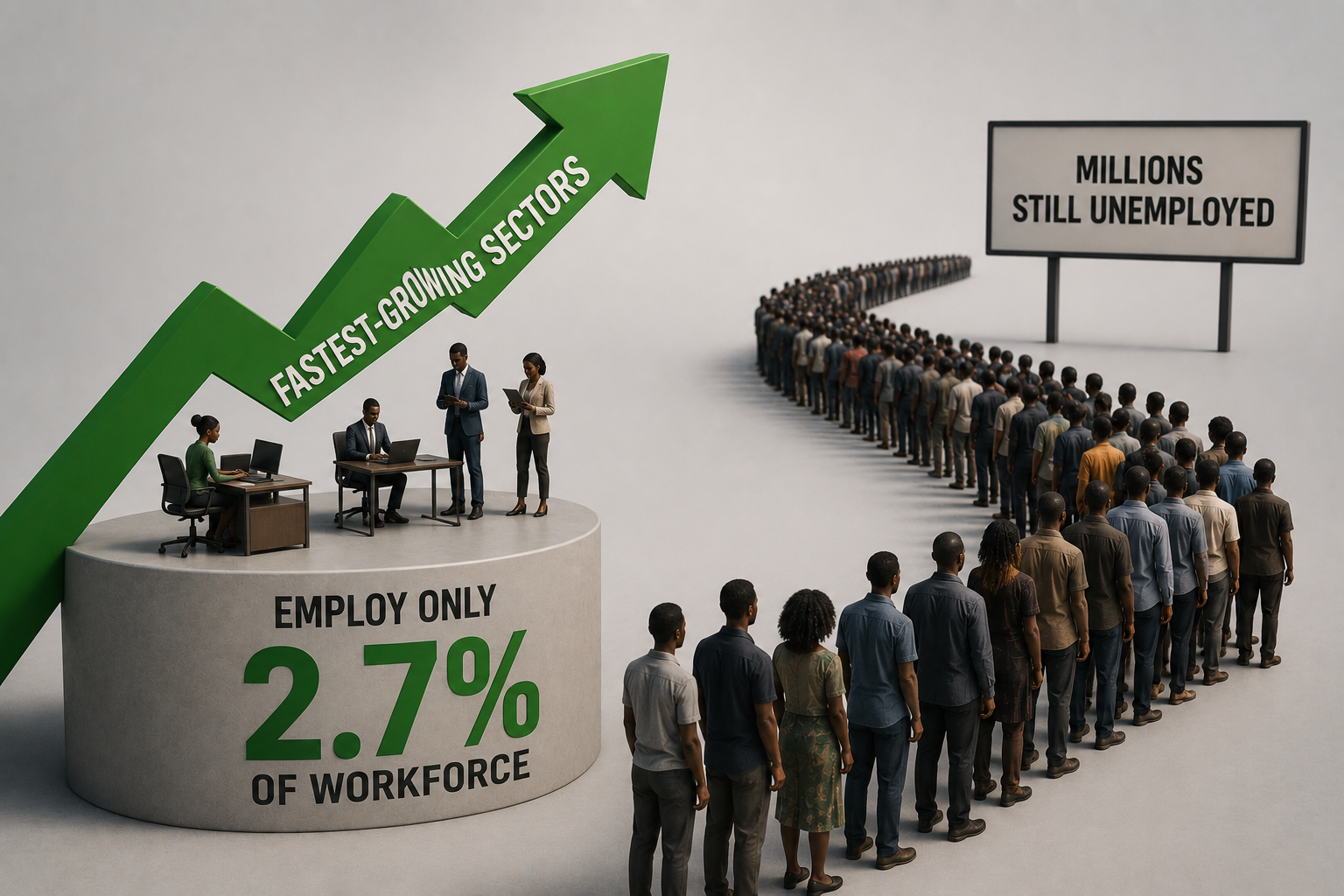
Nigeria’s fastest-growing sectors are creating too few jobs to make a meaningful dent in unemployment, with six high-growth industries employing just 2.7 per cent of the country’s workforce despite recording robust economic expansion over the past three years, according to a new report by investment firm CardinalStone.
The findings, contained in the firm’s 2026 Mid-Year Economic Outlook, highlight a widening disconnect between economic growth and employment generation, raising concerns that recent macroeconomic gains are failing to translate into improved livelihoods for Nigerian workers.
According to the report, the Administrative and Support Services sector recorded the highest average annual growth rate of 16.1 per cent over the past three years but accounted for only 0.9 per cent of total employment.
The Arts, Entertainment and Recreation sector grew by an average of 8.6 per cent while employing just 0.4 per cent of the workforce.
Financial and Insurance Activities recorded average growth of 6.6 per cent but accounted for only 0.6 per cent of employment, while Mining and Quarrying expanded by 6.4 per cent despite employing only 0.2 per cent of Nigerian workers.
The Real Estate sector posted average annual growth of 5.9 per cent while accounting for just 0.3 per cent of total employment. Similarly, the Information and Communication Technology sector grew by 5.1 per cent but employed only 0.3 per cent of the workforce.
Combined, the six sectors generated some of the strongest economic growth in the country but employed only 2.7 per cent of Nigerian workers.
By contrast, Nigeria’s largest employers recorded significantly slower growth.
Agriculture accounted for 30.1 per cent of total employment, wholesale and retail trade employed 27.5 per cent of workers, while manufacturing accounted for 12.7 per cent.
Together, the three sectors employ more than 70 per cent of Nigeria’s workforce, yet each recorded average annual growth of less than two per cent over the same period.
CardinalStone said the imbalance helps explain why improvements in headline economic indicators have not translated into higher incomes or better living standards for many Nigerians.
“This position explains the poor transmission of economic gains to the bottom of the pyramid with the country’s lack of inclusive growth,” the report stated.
The investment firm said Nigeria continues to experience what economists describe as the “jobless growth paradox”, whereby economic expansion fails to generate sufficient employment opportunities.
It added that recent economic growth has been driven largely by sectors that are less labour-intensive.
“The issue with growth inclusiveness is not new, as the country has witnessed a pattern in which sustained economic growth failed to commensurately boost the number of jobs over the last decade, a phenomenon known as the jobless growth paradox.
“Low labour-intensive sectors such as oil and gas and services have been the primary drivers of the recent macro gains and, hence, get a proportionate share of the associated income.”
The report also identified weak labour productivity as another factor constraining inclusive economic growth and broad-based job creation.
Despite these concerns, CardinalStone maintained its forecast that Nigeria’s economy will grow by 4.2 per cent in 2026.
The report comes amid persistent concerns over unemployment and underemployment, with many Nigerians continuing to struggle to secure formal employment despite signs of gradual improvement in the country’s overall economic performance.