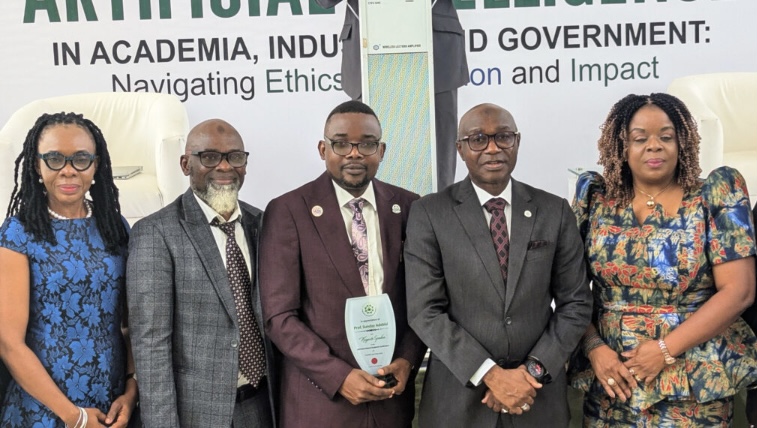
Artificial intelligence (AI) is reshaping jobs across Africa at a pace that is outstripping the continent’s ability to prepare workers for the changes ahead, experts warned on Tuesday at the 3rd International Academic Conference of the Chartered Institute of Personnel Management of Nigeria (CIPM), held at the University of Lagos.
The conference, themed “Artificial Intelligence in Academia, Industry and Government: Navigating Ethics, Innovation and Impact,” brought together stakeholders from academia, human resources, industry, and government. Participants noted that AI is already transforming employment across sectors including banking, education, agriculture, logistics, customer service, and public administration, with significant implications for jobs, skills development, and workforce readiness across Africa.
Delivering the keynote address, Prof. Sunday Abayomi Adebisi, Director of the Entrepreneurship and Skills Development Centre at the University of Lagos, said Africa must urgently define its own approach to artificial intelligence or risk becoming “socially obsolete”.
According to Adebisi, the central challenge is no longer whether AI will change the nature of work, but whether governments, institutions, employers, and workers are adequately prepared for the transformation.
“There is nothing we can do. AI is here,” he said, adding that the challenge lies in adopting the technology “in a way that does not destroy everything in Africa.”
Adebisi observed that artificial intelligence is already disrupting labour markets across multiple sectors, including banking, customer service, clerical and administrative services, manufacturing, logistics, agriculture, education, media, and parts of the public sector.
He stressed that Africa must confront the reality that AI will simultaneously eliminate and create jobs, noting that the scale of disruption will largely depend on the continent’s level of preparedness.
“If anybody tells you AI will not kill jobs, it is a lie,” he said, arguing that the focus should now shift towards managing workforce displacement while equipping workers for emerging opportunities created by technological advancement.
According to Adebisi, Africa is already grappling with high levels of unemployment and underemployment, while millions of young people enter the labour market each year without corresponding growth in job opportunities.
He warned that without deliberate planning and investment, the adoption of AI could exacerbate existing labour market challenges.
Adebisi further urged African countries to move beyond being passive consumers of technology and instead build the capacity required to participate meaningfully in global innovation ecosystems.
To achieve this, he called for comprehensive digital curriculum reforms, improved electricity supply, stronger digital infrastructure, and targeted workforce development initiatives focused on automation, data interpretation, software integration, and AI systems design.
He also emphasised the need for universities to evolve from institutions that merely produce job seekers into centres of innovation, research, entrepreneurship, and productivity.
In his opening remarks, President and Chairman of the Governing Council of CIPM, Mallam Ahmed Ladan Gobir, FCIPM, fnli, said artificial intelligence is already transforming how people learn, work, and govern, describing it as a profound shift affecting classrooms, workplaces, and boardrooms alike.
Gobir noted that while technology will play a significant role in shaping the future of work, human values and responsibility must remain central to its deployment.
“The future will not be determined by algorithms. It will be shaped by human responsibility,” he said.
He cautioned that innovation without ethical safeguards could become harmful, stressing the importance of fairness, transparency, inclusion, and accountability in the development and application of AI technologies.
Gobir said the conference was intended to move beyond theoretical discussions and generate practical outcomes capable of informing policy, strengthening ethical frameworks, and ensuring that AI serves the broader interests of society.
He also encouraged professionals and students to prepare for the evolving world of work by acquiring future-focused skills and actively engaging with professional bodies such as CIPM.
In a goodwill message delivered on behalf of the Director-General of the Nigeria Employers’ Consultative Association (NECA), Adewale-Smatt Oyerinde, Assistant Director, Learning and Development at NECA, Isabella Usen, said AI is already redefining work, education, and governance.
Usen noted that artificial intelligence is enhancing teaching, research, curriculum development, and institutional administration within academia, while improving productivity, innovation, and customer experience across industries.
She added that governments are increasingly deploying AI to strengthen public service delivery, policy formulation, tax administration, and regulatory efficiency.
According to Usen, the successful adoption of AI will depend on the establishment of robust ethical and regulatory frameworks capable of safeguarding privacy, ensuring accountability, promoting fairness, and maintaining public trust.
She stressed that human resource professionals have a critical role to play in managing workforce transitions through reskilling, upskilling, and ensuring that technological transformation remains people-centred.
Usen further emphasised that sustained collaboration among academia, industry, government, and HR practitioners is essential to achieving inclusive and sustainable AI integration.
The conference also featured sessions on AI ethics, human-AI collaboration, and sustainability, with participants examining how emerging technologies can contribute to socio-economic development and support the achievement of the Sustainable Development Goals.
Organisers said the event was designed to deepen engagement between CIPM and academic communities in Nigeria, across Africa, and globally, while promoting responsible innovation that balances technological advancement with job creation, ethical governance, and long-term societal impact.