
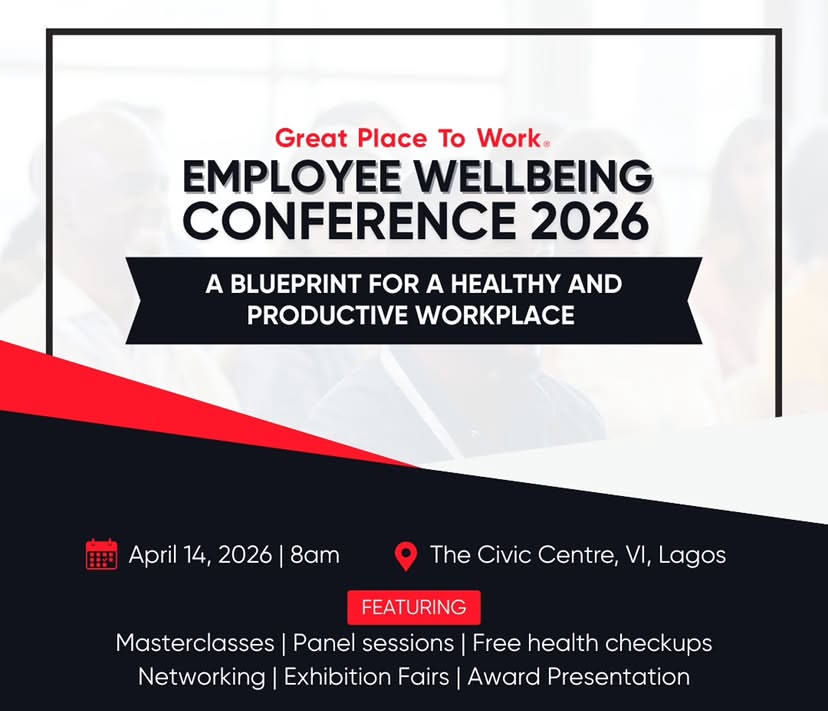
Employee wellbeing took centre stage in Lagos as Great Place to Work urged organisations to prioritise the health and welfare of their workforce as a strategic driver of productivity and growth.
The organisation made the call at its 2026 Employee Wellbeing Conference, themed “A Blueprint for a Healthy and Productive Workplace”, held on Tuesday in Lagos. The event convened business leaders and HR professionals to examine how improved employee wellbeing can enhance performance, retention, and overall business outcomes.
Speaking at the conference, Country Manager of Great Place to Work Nigeria, Mr. Otamere Elegon, said the initiative responds to growing concerns around mental health and workplace culture. He noted that organisations that prioritise their people not only foster better work environments but also outperform competitors, with certified companies exceeding others by approximately 11 per cent.
In his opening remarks, Elegon stressed that wellbeing is no longer the sole responsibility of HR but requires organisation-wide ownership. He observed that employees are increasingly voicing concerns about mental health, adding that trust remains “the currency of any organisation” and is fundamental to building a thriving workforce. He further called for a rethink of work systems, urging organisations to reduce reactive work styles and design environments that promote innovation and balance.
According to him, workplace culture extends beyond organisations and has broader national implications. He encouraged companies to assess the level of trust employees place in leadership and urged wider participation in Great Place to Work initiatives to raise standards across industries.
Guest speaker, Dr. Adewale Olaolu, Head of Medical Advisory at Hygeia HMO, underscored that good health underpins workforce effectiveness. He explained that without sound physical and mental health, employees cannot sustain focus, energy, or efficiency. He cautioned that long working hours and fatigue diminish productivity and advised workers to prioritise regular health checks, monitor key indicators such as blood pressure and BMI, and take their leave entitlements seriously.
Olaolu also highlighted the risks of hypertension, describing it as a major health concern in Nigeria. He urged employees to invest in their wellbeing through regular physical activity and healthy lifestyle choices. “No employee is indispensable,” he said, calling on organisations to establish systems that enable adequate rest and recovery.
During the event, several Wellbeing Ambassadors were recognised for their contributions to promoting mental, emotional, and physical health within their organisations. Organisers noted that the awardees had gone beyond their formal roles to support colleagues, raise awareness, and foster supportive work environments.
In a panel session titled “From Initiative to Imperative: Positioning Employee Wellbeing as the Heart of Business Strategy,” moderator Fabia Ogunmekan, Principal Consultant, ADABA Initiatives said wellbeing has evolved from a “nice-to-have” HR function into a core business priority. She noted that forward-looking organisations are embedding wellbeing at the centre of their strategies due to its direct impact on engagement, productivity, and retention.
Panellists agreed that employee wellbeing is now a critical driver of business success, with measurable effects on profitability and reduced employee replacement costs. They also emphasised the importance of both formal and informal communication channels, alongside sustained leadership commitment to cultivating a supportive workplace culture.
Also speaking, Dr. Jekwu Ozoemene, Executive Director at The Alternative Bank, highlighted the need to build inclusive workplaces, particularly for neurodivergent individuals. He said organisations must align roles with employees’ abilities and address issues such as sexual harassment through clear policies and enforceable consequences.
Ms. Olubukola Lanipekun-Lawal, Head of Human Resources at FSDH Merchant Bank, emphasised the centrality of leadership and communication in fostering a strong wellbeing culture. She noted that leaders must not only care for employees but demonstrate that commitment through their actions. “When employees are not happy coming to work, something is wrong,” she said.
Lanipekun-Lawal added that her organisation leverages both technology and direct engagement to capture employee feedback and respond effectively. She explained that creating a sense of belonging and valuing employees’ voices enhances talent retention and organisational performance.
Another panel session, “Designing Workplaces that Sustain Wellbeing: Leadership, Culture, and Systems,” explored how organisations can embed wellbeing into their structures. Olanike Martins, Chief People Officer at Premium Trust Bank, said employee wellbeing extends beyond physical health to encompass social, emotional, spiritual, and financial dimensions.
“Employee wellbeing is beyond physical health. It speaks to the social, emotional, spiritual, and financial. It is the totality of life. Today, people come to work as whole persons, so you cannot separate it,” she said.
Dipo Adebajo, Head of Human Resources at Sterling Bank, stressed the importance of consistency in promoting wellbeing across organisations. He said organisations must continuously advocate policies that support both men and women across different generations, adding that wellbeing initiatives should be sustained rather than occasional.
In his contribution, Felix Bissong, Lead Consultant at The GenZ HR, said organisations must align wellbeing initiatives with employee engagement and performance metrics. He noted that when wellbeing is fully integrated into business strategy, it delivers improved outcomes for both employees and organisations.
Adejoke Alli, Associate Director, Business Operations at Fidson Healthcare Plc, said employee happiness has a direct correlation with productivity. She recommended the use of data and analytics to measure wellbeing and track its impact on organisational performance.
The conference concluded with a strong call for organisations to embed wellbeing into their core systems, with speakers unanimously agreeing that a healthy workforce is essential to sustainable business growth and national development.