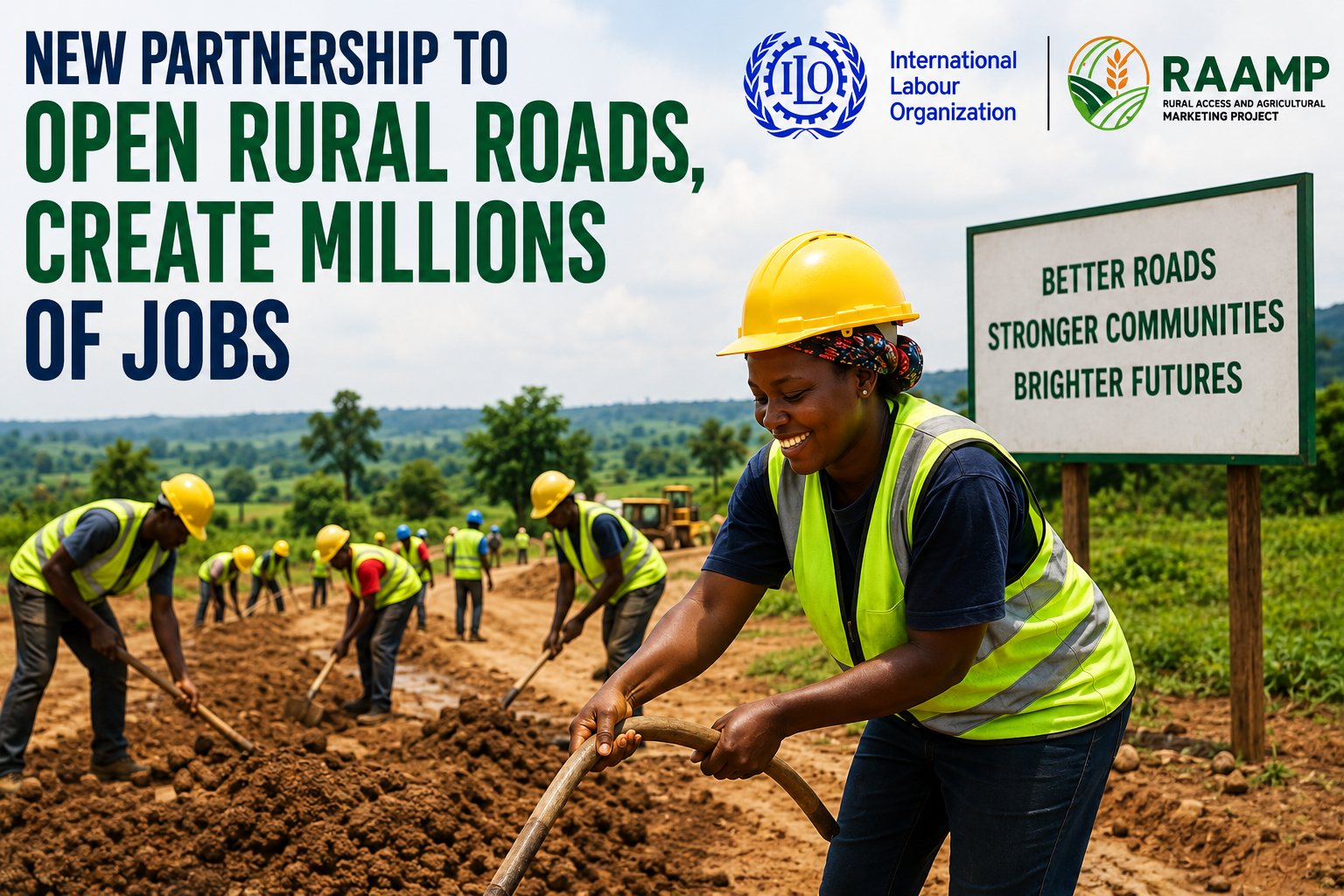
The International Labour Organization (ILO) and Nigeria’s Rural Access and Agricultural Marketing Project (RAAMP) have signed a new agreement aimed at expanding employment-intensive rural road maintenance systems across 12 states, in a move expected to generate more than four million workdays while improving rural connectivity, market access, and livelihoods.
The agreement, signed in Abuja, will see the ILO provide technical assistance for the implementation of approximately 2,400 kilometres of routine rural road maintenance and 1,200 kilometres of targeted road improvement works between February 2025 and May 2029.
According to the partners, the initiative is expected to generate about 1.5 million workdays through direct employment, alongside an additional 2.7 million workdays through indirect job opportunities.
The programme will focus on promoting decent work, skills development, and social inclusion, with particular emphasis on increasing the participation of women and persons with disabilities in rural infrastructure jobs.
RAAMP is one of the largest rural infrastructure and agricultural market access programmes in Nigeria and across Africa. The project is jointly funded by the World Bank, the French Development Agency (AFD), the European Investment Bank (EIB), the Islamic Development Bank (IsDB), and the African Development Bank (AfDB).
The programme is designed to improve access to rural communities, strengthen agricultural value chains, and support the sustainable management of rural road assets in participating states.
Under the new agreement, the ILO’s technical assistance support to RAAMP will increase by US$6.7 million, bringing the organisation’s total support package for the programme to US$10.7 million.
Speaking during the signing ceremony in Abuja, RAAMP National Coordinator, Mr. Aminu Bodinga Mohammed, described the partnership as a major step towards building sustainable road maintenance systems capable of delivering long-term economic and social benefits for rural communities.
“This partnership reflects our commitment to preserving rural infrastructure investments while creating jobs and strengthening livelihoods in rural communities,” Mohammed said.
He added that sustainable maintenance systems were essential to ensuring that rural roads continued to support agricultural production, improve market access, and drive local economic growth.
Also speaking, Branch Chief of the ILO Employment Intensive Investment Programme (EMPINVEST), Ms. Mito Tsukamoto, said the collaboration demonstrated how infrastructure investments could simultaneously support economic growth and create decent jobs.
“Rural infrastructure can deliver much more than roads. When designed with people at the centre, it can create jobs, strengthen local economies, and build more resilient communities,” she said.
Tsukamoto added that the partnership reflected a shared commitment to promoting decent work through sustainable infrastructure development while ensuring that women and other excluded groups benefited from the opportunities created.
ILO Country Director for Nigeria, Ghana, Liberia, and Sierra Leone, Dr. Vanessa Phala, also stressed the importance of linking infrastructure investment with inclusive employment and skills development.
“At the heart of this collaboration is the recognition that infrastructure development and decent work must go hand in hand,” Phala said.
She explained that the employment-intensive approach would help create jobs, strengthen livelihoods, and contribute to inclusive and sustainable economic growth.
The partnership will also support capacity development for government institutions, contractors, and implementing partners to improve the long-term management and maintenance of rural roads.
The RAAMP Scale-Up Programme is expected to rehabilitate and upgrade approximately 3,000 kilometres of rural roads to climate-resilient standards, while also supporting the maintenance of an additional 3,500 kilometres of rural road networks across participating states.
According to the partners, the project is expected to improve access to markets, services, and economic opportunities for rural communities across the country.